Segment, Stage, and Tag: The Three-Layer CRM Structure Most Agents Never Build
Aug 25, 2026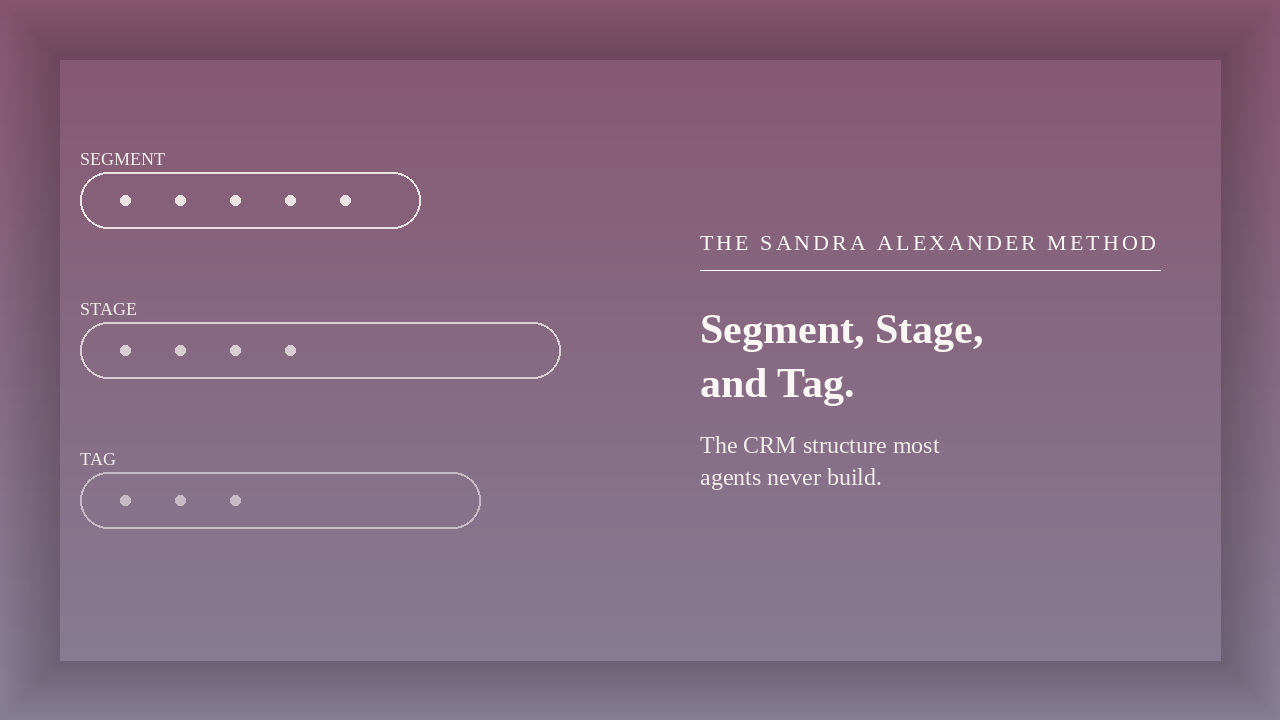
Most CRMs fail quietly, not dramatically. They don't crash. They just slowly turn into a pile of contacts with no real structure — every piece of information about a person crammed into one field, or scattered across notes nobody reviews.
The fix isn't more data. It's a clearer structure for the data you already have. Specifically, three layers that each answer a different question.
Why One Field Isn't Enough
Ask most agents how their CRM is organized, and the answer is usually one dimension: "past client," or "buyer," or "hot lead." That single label is being asked to do the work of three separate pieces of information — who someone is, where they are in their journey, and how they connect to your business. No wonder it stops being useful as the database grows.
Three layers solve this, and each one answers a question the others can't.
Layer One: Segment — Who They Are
Segment answers a simple question: what's your relationship to this person? Buyer, Seller, Partner, Vendor. This is the most stable of the three layers — it rarely changes, and it defines the basic shape of the relationship.
Notice this isn't "Past Client." That label describes history, not the current relationship, and it tells you nothing about what to do next. Think about how your doctor's office treats you — you're not filed away as a "past patient" the moment you leave an appointment. You're still their patient, and they see you again. The same logic applies here. A buyer segment tells you the kind of conversations and content that person actually needs, long after the closing is behind you.
Layer Two: Stage — Where They Are
Stage answers a different question: where does this relationship stand right now? Hot, Warm, In Contract, Closed, Lost. Unlike segment, stage moves constantly — sometimes within the same conversation.
This is the layer most agents skip building properly, because it requires actually updating something the moment a relationship shifts, rather than setting it once and forgetting it. A Warm buyer who mentions a firm move date becomes Hot immediately, not next time you happen to review your list.
Layer Three: Tags — How They Connect
Tags answer a question segment and stage can't: what specific list does this person belong to? This is where the personal, human details live — dog lover, art collector, gardener, tennis player — alongside operational ones, like the year you closed with someone or whether they're on your newsletter list. Tags are the layer that lets you pull a precise group instantly, whether that's everyone who closed in 2023 or everyone who should receive this month's newsletter, without touching segment or stage at all.
The same logic applies to referral tags, with one distinction worth knowing: a referral tag marks that someone belongs to that group, so you can pull the whole list on demand. It's not the same as Cloze's "Referred By" field, which lives in a contact's details and records who specifically referred that individual person. One tells you a group. The other tells you a connection. Use both, and you get the full picture — who sent you this client, and who your referral network actually is as a whole.
This is also the most flexible layer. You can add and remove tags freely without disrupting the core structure the other two layers provide.
Why All Three Together Matter
Used separately, each layer is useful. Used together, they let you ask precise questions of your database instead of scrolling through it. Who are my Hot buyers who are also referral sources? Segment and stage and tag, combined, answer that instantly. A single-field system never could.
This is also what makes a CRM scale. A database with fifty contacts survives on memory. A database with two thousand doesn't — it needs structure that does the remembering for you.
Building It Without Overwhelming Yourself
Don't try to retrofit all three layers onto your entire database in one sitting. Start with your active relationships, apply all three layers correctly, and let that become the standard for every new contact going forward. Older contacts can be brought up to structure gradually, as you touch them again naturally.
The goal isn't a perfectly labeled database on day one. It's a structure that gets more useful every time you use it, instead of one more thing to maintain.
If building this structure inside Cloze feels like more than you want to figure out alone, this is exactly the setup I walk agents through inside The Sandra Alexander Method — done once, and done right.
About Sandra Alexander: Sandra is a Global Real Estate Advisor with ONE Sotheby's International Realty in Vero Beach, Florida, and the founder of The Sandra Alexander Method. After over a decade in real estate, she built a thriving, referral-based business by creating the systems, workflows, and structures that others kept asking about. Today, she teaches agents how to set up Cloze CRM the right way — so they can deliver exceptional service, stay top of mind with past clients, and build a business that runs with confidence and clarity.
Stay connected.
Join my community of real estate professionals building more intentional, relationship-driven practices. I share insights, systems, and strategies from my own business — nothing generic, nothing scripted.
Your information stays with me. Always.
We hate SPAM. We will never sell your information, for any reason.
